




BC HOCKEY HONOURARY LIFE MEMBER - BRUCE ALLISON
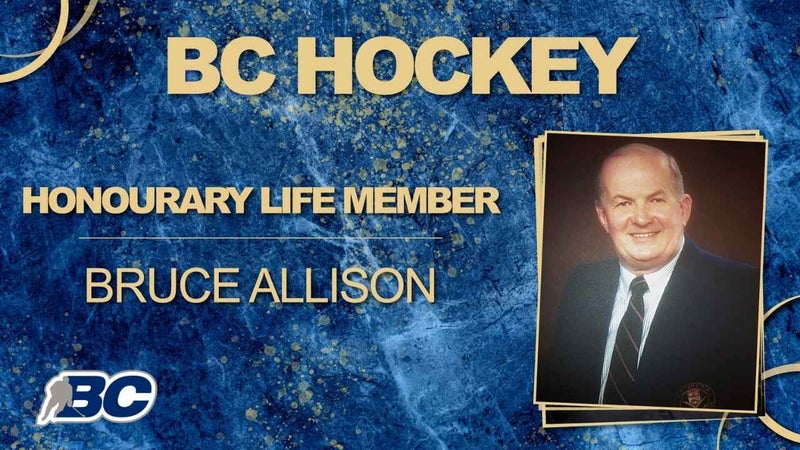
By MARIO ANNICCHIARICO
What are the most distinguishing factors in becoming a BC Hockey Honorary Life Member, you ask? Well, you can start with dedication, hard work and a passion for the sport.
This year’s honouree, Bruce Allison - who is being inducted posthumously – was no different and he is being recognized with this distinction, which is presented to an individual recognized for outstanding service, commitment, or contribution to BC Hockey.
“Bruce was a very dynamic individual and I think the two things that struck me about Bruce is how many hours he put into being president of BC Hockey,” said Bill Ennos, who was named an Honorary Life Member in 2022.
“Also, his philosophic approach to the game and the minor hockey associations and that sort of thing was totally based on the value that we could bring to the kids and the volunteers.
“Those two things were what Bruce was all about, and he was (BC Hockey’s) president in some trying times. It was back in the days where residency, with winter clubs, and all those hot topics fell on his shoulders,” added Ennos.
“I think, after everything was said and done, he had no enemies. He had no reason for being, other than his founding principles and I really respected him for that and the way he went about the business.”
Allison is described an innovative, dedicated and outstanding leader in amateur hockey in the province for more than 30 years - right up until his death in 1990.
He served as a minor hockey association founder and president in the early 1960s (Gulf of Georgia - later Seafair MHA in Richmond); volunteered as division manager in the Pacific Coast Amateur Hockey Association (PCAHA) for many years, beginning in the mid-1960s, then later as vice-president and president of the PCAHA.
Allison then went on to serve on the Board of Directors and as vice president and president of the British Columbia Amateur Hockey Association (now BC Hockey) for a decade. He was also a member of the Canadian Amateur Hockey Association (now Hockey Canada) Board of Directors from 1985-1988.
He was also the original owner and general manager of the Richmond Sockeyes junior hockey franchise and one of the founders of the PAC-A Junior A league that operated in the Lower Mainland from 1974 to 1980. The purpose of this league was to encourage junior A players to compete at a high level, while still completing their high school education.
Allison served as president of the BCJHL (now BCHL) Junior A league from 1988 until his death in 1990. He won the BC Hockey Diamond Stick Award in 1990.
“He spent absolute hours and hours on hockey and I think we were better off for it,” said Ennos. “I think you could phone 100 people from back in that day, or that era, and ask for comments about Bruce and I would doubt whether anything would be negative.
“He had some challenges and he met those head-on and he met them in a way that people enjoyed dealing with him after everything was said and done and moved on. Some of those issues were not pleasant issues, but I don't think anyone ever regretted dealing with Bruce on issues like that.”
Allison and his wife Emily had five children, including sons Jim and John, who both played hockey.
“I think that the best way to encapsulate our father was he just loved the game,” said Jim. “He liked talking about it and he talked the ear off anyone that wanted to talk about the game. And I would say he did it for decades - his entire life, really.
“The only reason he stopped, of course, was he unfortunately got sick and died. He loved everything about the game and he even went to Finland a couple of times, and this was before Finland became a prominent hockey power, as they are now, because they had tremendous interest in the game and learning from Canadians.”
His passion for the game remained until the end.
“He was especially concerned about hockey in the late ’70s, early ’80s,” said Jim. “Enrolment was declining and he felt - and I think accurately - that the game had a very violent reputation in those days. There were fights and I remember when I played junior hockey and when there was one fight; invariably everybody on the ice dropped their gloves and grabbed onto each other, and that often led to several fights.
“He thought that was killing the game. Sure, I guess junior fans are entertained by it, but it was frightening parents of little kids who thought, ‘Why would I put my kid into that,’ So he worked pretty hard on cleaning up the game.”
Which faced some resistance from those who thought it was maybe too progressive.
Jim also felt his dad focused on learning the skills of the game and having fun.
“He recognized early on that, overwhelmingly, kids aren't going to the NHL and, overwhelmingly, most kids play non-competitive hockey, if you will. Or, in those days called house league hockey; recreational hockey, and hockey needs to be for everyone.”
The elder Allison believed hockey needed to be accessible for everyone and not just focused on the elite level kids. He felt if you had the foundation of joy in the game you could play it forever, said Jim.
“The second big thing was education. Like up to 1980, most Junior A kids often left home to play and had likely dropped out of school. The Western Hockey League was playing an NHL-type schedule of 72 or more games and it's hard to go to school,” said Jim.
“You're on the bus for six, eight, 10 or 12 days at a time and so dad felt that was a dead-end for lots of young people. They go to junior; it doesn't work out for them and they've only got Grade 11. Or they're 19 and four courses short of graduating from high school.
“So he was passionate about strengthening the connection between continuing education and hockey, whether it was through scholarships or at one time in his life, in creating a Junior A league in the Vancouver Lower Mainland area. So those kids could continue to play junior A hockey with pathways to post-secondary or beyond and, if possible, go to their own high school, right?”
Jim, himself, played junior hockey and eventually played five seasons for the UBC Thunderbirds, building his own passion for the game, like his father had, volunteering for years.
“His whole life, you had to love the game because if you didn't, you were out of pocket. No one got paid for any of these positions, whether it was coaching or organizing hockey schools. It was cost recovery or less for most of these kinds of programs,” said Jim.
Unfortunately, his father was diagnosed with cancer at age 60 and died at 61. He’s gone, but never forgotten and now he will be remembered even further as a BC Hockey Honorary Life Member.
“Yeah, I mean, I think it's interesting and definitely an honour,” said Jim. “I think the further removed I am from it, the more I look back and I do remember that hockey was something he loved talking about - watching it, talking to people about it, talking to people's experiences with the game. He certainly dedicated his life to it.”